Moshi and Kilimanjaro were pretty much a blur for me. We left Dar es Salaam and embarked upon a painfully long 10 hour drive up to Moshi in Northern Tanzania and by the time we arrived I (Chris) was really sick with a cold/flu and spent the next two days in bed, feeling really sorry for myself while Fiona and the boys explored Moshi and the foothills of Kilimanjaro without me. They apparently had a wonderful time… I lay in bed watching some DVDs we had bought off the street in Lusaka: $2 Chinese pirate copies of some really terrible films. The boys were definitely impressed, once they had seen Kilimanjaro up close, that their mum had climbed it last year. It took on a new dimension for them (and me) looking at that 20,000 feet and a big snow-capped peak.
As soon as I started to feel vaguely human again, we took a step closer to Ngorongoro and the Serengeti by moving just past Arusha, the town that is the gateway to the safari part of Tanzania.
Tanzania takes its safari really seriously. The safari industry here is enormous and very-well organised, almost exclusively catering to overseas tourists. And its a lot different from the Southern African self-drive safari idea. In Tanzania (much as in Kenya), almost everyone is taken in varying degrees of “luxury” on safari by specialist safari tour companies. We met one couple who had four staff (a chef, a guide, a lackey and a driver) and two vehicles to themselves and were eating like kings. At the other end of the scale, we met overlanders who were cooking their own pasta over charcoal fires. People driving their own vehicles into the parks is a real rarity and things aren’t made particularly easy for you if you do want to take your own vehicle. This part of Tanzania is a lot more expensive than southern Africa. We paid about $300/day/night all in for all of us as opposed to about $50/day/night in southern African national parks. For even the most simple safari, people were paying $300/day/night per person and up to ludicrous figures for the really high end safaris ($4000/day/night ++). But Ngorongoro and Serengeti were worth the effort and expense.
This part of Tanzania is pretty much all about the tourism industry and everyone’s in on the game. Continually negotiating with Tanzanians over everything is a bit exhausting… They see a “mzungu” and suddenly the prices are trebled at least – but we’ve been buying local for 2 weeks now and know, definitively, that a loaf of bread does not cost $4. We even have to negotiate in the road-side restaurants where a simple plate of french fries really costs $0.80 but they regularly try to charge us $3. We stopped yesterday to ask some locals where to find charcoal. “Oh, I’ll get it for you. How much do you want?”. Wait while he runs 50 meters and appears with a plastic shopping bag full of charcoal. “25,000 shillings.” ($16). Roll eyes and start a 5 minute negotiation that results in a stalemate… and so it goes. Even the Masai, who are living in the remotest villages are in on it: 5000 shillings for a photo, negotiable of course.
We arrived late at the Ngorongoro Conservation Area in the afternoon and waited until late in the afternoon to time our drive to the campsite on the lip of the crater perfectly. Every hour in the parks is really expensive (well, relatively) so we wanted to make the best use of our time. The Ngorongoro Conservation Area and Serengeti National Park are adjoined – you have to drive through the Ngorongoro Conservation Area to get to the Serengeti. The difference between the two parks is that the Masai are allowed to live in the Ngorongoro with the animals but not in the Serengeti. The big draw at the Ngorongoro Conservation Area is the crater – about 300 sq km of the most outrageous animal/game viewing on the planet. It was astounding. We camped on the lip of the crater in a big public camp site with about 200 other people on various safari and overland trips and woke up at 5 a.m. to get down into the crater for sunrise. As we drove down into the crater with our obligatory guide, Daniel, installed in the front passenger seat, lions walked right by us, within a meter of the car, completely ignoring us. And so it continued. There are about 300 lions in the crater and they just lie around as safari vehicles full of amazed tourists drive around them. Add to the spectacle of the lions, the enormous numbers of elephants, the zebra, buffalo and hyena in such a tiny area and you have an incredible experience. The lion are so well-fed that they ignore the Masai who walk around liberally within the crater – though the Masai’s herds are sometimes attacked.
We left the Ngorongoro Crater in the late afternoon to drive through the remainder of the conservation area before our 24 hours were up and enter the Serengeti National Park. We camped in the centre of the Serengeti at an open camp – and it’s blinking amazing we got any sleep at all. Hyena were wandering through the camp and making a hell of a creepy racket, and buffalo stood between us and the toilets for most of the night and early morning. As we were unpacking our tents, elephants wandered through the camp. We wouldn’t have even dared to stay in a camp with the kids like this at the beginning of the trip but we’ve relaxed a bit and the boys are remarkably responsible and respectful of the dangers… more likely to have been due to the crocodile attack in Zambia than parental lecturing.
The Serengeti was a very different experience from the Ngorongoro – the animals are very spread out in the Serengeti – except of course when you find them. When you find zebra or wildebeest, there are literally thousands in a huge herd stretching to the horizon. The Serengeti was absolutely beautiful. I had an idealised vision of how the Serengeti plains would look – and they didn’t disappoint: stunning acacia trees, deep blue sky and grassy plains. Beautiful, awesome.
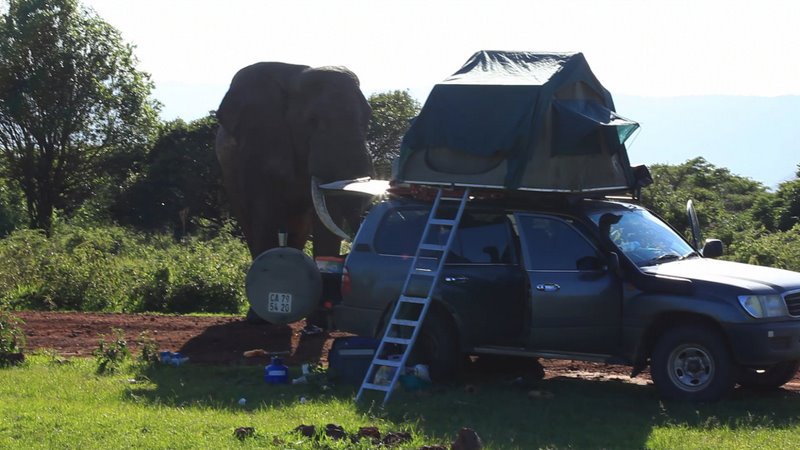
Our third night was spent back at the Simba campsite on the lip of the Ngorongoro crater. We arrived late having picked up a hitch-hiking Masai herdsman as we were trying to repair yet another puncture… amazing guy who spoke Swahili, German, French and English and told the kids about how his herd had been attacked by lions and he was forced to kill one. The next morning we woke much later than normal and as we were slowly packing up, a lone bull elephant emerged from the bush and wandered towards our car. I (Chris) got the three kids into the nearest place we could hide without drawing more attention to ourselves, the roof tent on the car, and we nervously watched through the side window as this enormous elephant picked through our food supplies eating coffee, Weetabix and corn flakes and deposited large gobs of elephant snot on the rest of the food. Fiona, who had been off somewhere filming, calmly asked the safari guides to help scare off the elephant which they did by driving a safari vehicle down towards the elephant and revving the engine.
The last day in Ngorongoro/Serengeti was spent at a place called the Shifting Sands, magnetic volcanic sands that move 17m a year, where we met a village of Masai (see pictures). Fiona led us on an expedition to the Olduvai Gorge, the site where the Leakeys discovered a whole number of hominids, and where the Leakey family continue to live and dig. All in all, the Ngorongoro/Serengeti was incredible….
We’re slowly heading down towards Malawi now but have no real plan as such. I’m still sick (I don’t have malaria, I got tested) and operating at about 1/2 speed.
We’re continuing to have an amazing adventure that a few blog entries and some pictures don’t do justice… Stay tuned for Fiona’s documentary though!
We’re all well and really enjoying the messages from everyone!
See the photos on Facebook:
Comments
3 responses to “Kilimanjaro, Ngorongoro and Serengeti”
Wow!
Magical! You deserve prizes for these lovely reports!