It is said that changing jobs and selling/buying houses are the two most stressful events in life. We’ve got those two well-covered and if you add putting your children in life-threatening situations, we’re heading off the scale.
Over the past couple of weeks we’ve been discussing and vaguely planning what to do in Botswana. We are travelling around Botswana with our friends Simon and Elme, and their 3 kids (aged 12, 9, 7). Initially, the guys led the “planning” of a route. This, somewhat stereotypically, resulted in a route that would guarantee, according to more sage and enlightened individuals, that we’d lose a couple of children at best or all die in a remote swamp with hyenas picking at our bones at worst. Apparently, in spite of my 9 years of practical experience living with children, I still have some consideration shortcomings to overcome – and their blog entry probably should have set off some alarm bells.
The guy-plan was to start in Maun, a largish town in Northern Botswana where safari folk explore the Okavango Delta, and stock up on food, water, fuel and cappuccinos before heading into the bush. Our plan was to leave Maun and head into Moremi Wildlife Reserve, up into Chobe National Park and then to Kasane Forest Reserve, near the Zambian border and Victoria Falls. Eminently sensible. On the surface of it.
Maun is located just to the south of the Okavango Delta, a huge swampland inhabited by crocodiles, hippos, elephants, lions, hyena, buffalo, leopards, cheetahs and much more. This part of the plan passed the approval process. So we’ll explore the Okavango from Maun, taking boats out into the Delta.
Moremi Game Reserve is 180kms north of Maun. Once in the reserve, there is no water, fuel or food – so one needs to be totally self-sufficient. As we’d be going in the summer (rainy season), most of the tracks will be mud swamps in which 4×4 vehicles regularly get stuck. Madness, apparently. If you get stuck you just have to wait for another vehicle to pass – could be days, weeks even during the summer. And there’s no cell phone coverage. The bridges over the swelling rivers are made of mopane wood and are often completely washed away during the rainy season. The camps within the park are completely open to the animals, including lions and hyena. The animals are habituated – they aren’t particularly put off by humans and lions and hyena roam freely throughout the camp at night. Moremi is out. Finito.
Unfortunately, the 4×4 track from Moremi Wildlife Reserve through Chobe National Park and up to Kasane, which is tough at the best of times, is a total nightmare in the rainy season – and given that we’d never get out of Moremi alive anyway, our plans to head through Chobe National Park from Moremi, not surprisingly in retrospect, failed the approval process too.
The Central Kalahari is legendary for it’s untamed savanna/desert wilderness and amazing wildlife. It is the second biggest park/reserve in the world – when northeastern Greenland inevitably melts, it’ll be the largest. Visiting the Kalahari was a bit of non-negotiable for me – going to Botswana and not camping there was out of the question. It’d be like hauling yourself all the way to Newfoundland and then not kissing a fish. Or going to Paris and not visting the Moulin Rouge. Or going to Amsterdam and not… Anyway, the Kalahari is totally remote. There is no fuel, water, shower or food within 30 kms of the park and the park itself has nothing… and it is huge – more than twice the size of Vermont. The “campsites” are just patches of ground and most people tend to camp wherever they can find a tree, in the open. Toilets, fortunately, are ubiquitous – just bring a shovel. But the Kalahari is supposed to be brilliant in January. The rains will have hardened the normally deep sandy tracks making driving easier and it’s lambing season. January brings the birth of baby springbok and all the big, mean African predators you can imagine to feast upon the unsuspecting doe-eyed masses. Good stuff, solid entertainment. Oddly, despite the promise of an horrific and potentially disturbing bambi-slaughter, this suggestion has stayed on the agenda. Better them than us, I guess.
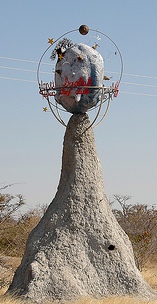
The (checking spelling again) Makgadikgadi (pr. ma-caddy-caddy – think Tiger Woods rapping) Pans are huge salt pans south-east of Maun – about the size of Switzerland. You may have seen the Top Gear episode where the hosts drove three mildly clapped out South African-bought cars across the vast salt pans without so much as a tree on the horizon. No probs. If that middle-aged Jeremy Clarkson fellow can do it in a Lancia Beta, how hard can it be? Well, that was winter (dry season) and if we tried that in January the crusted muddy pans would apparently swallow us and our big 4×4 vehicle whole – schloop! – the global population of Tudor Prices would suffer a catastrophic 15% loss. In the summer, the pans host herds of migrating wildebeest and zebra, and their predators like lions, cheetahs etc. More killing. We’re going to visit the pans but we’re starting on a sporadically paved road that presumably won’t sink. The road runs pretty much through the middle of the Makgadikgadi pans so, if we feel suicidally adventurous, we might head off to Kubu Island or Baine’s Baobabs. We’re probably going to camp at a place called “Planet Baobab”, a desert site in the middle of the pans.
We’ll leave the Makgadikgadi pans and head to Nata to camp and check out the Nata Bird Sanctuary. From there, we’ll head towards Kasane – a 6-ish hour drive. Kasane is at the very top of the Chobe National Park, on the Zambezi river bordering Zambia. There’s an, again sporadically, tarred road that will take us from Nata, on the east of the Makgadikgadi Pans, all the way up through the Sibuyu Forest Reserve and the Kazuma Forest Reserve. There are lots of great camping spots along the way.
So there you have it – a result. An exemplary marital compromise: an amazing time and intact children. That’s the plan and we are sooooo not sticking to it.